Journal Article · Journal of Disability & Religion · 2022
Toward Accessible Faith & Flourishing
Reconsidering Greek intellectualism in Western Christian theology: an illustrated overview of the open-access article.
Keith Dow, “Toward Accessible Faith & Flourishing: Reconsidering Greek Intellectualism in Western Christian Theology,” Journal of Disability & Religion 26, no. 4 (2022): 439–458. This page introduces the article's argument; page numbers refer to the journal pagination. Read the article itself for the full argument and references.
Overview · pp. 439–440
The argument in brief
From its beginnings, Western theology has been fascinated with ancient Greek philosophy. As seen in Augustine and Aquinas, the resulting framework privileges rationality in the “natural order” and in the pursuit of virtue and flourishing. The article asks what that inheritance has meant for people with intellectual disabilities, and what disability theology should do about it.
Map of the argument
Stage 1 of 5 · pp. 440–441
Human worth is tied to human reason. Plato’s Timaeus pictures a hierarchy that beings descend as they lose the use of reason. Aristotle ranks people by how fully their deliberative reason is expressed.
Go to this part of the overview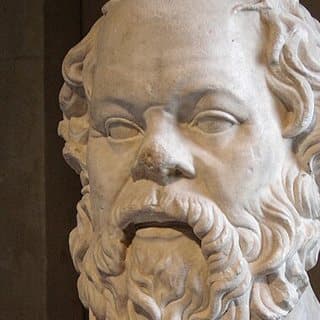
“I am likely to be a little bit wiser than he in this very thing: that whatever I do not know, I do not even suppose I know.”
Socrates claims the wisdom of humility over hubris: accepting the limits of what he knows rather than flaunting intellectual ability. Christian theologians, the article suggests, have at times followed “the hubristic aspirations of Greek thought” instead of Socrates' wisdom of not knowing, or the example of Christ's humility (pp. 439–440).
Scope
The article does not weigh the overall merits of Greek influence on Christian thought. Nor does it set out to discredit Augustine or Aquinas, whom it credits with real insight on disability. Its focus is narrower: how uncritically keeping specific Greek tenets has undermined the flourishing of people with intellectual disabilities (pp. 440, 443).
What the future of disability theology must do (p. 440)
- Interrogate the tendency to privilege rational capacity, in its various expressions.
- Question the overestimation of intellectual deliberation in ethical action.
- Refuse to project ableist models of happiness and human flourishing onto others.
- Open ways of being together in community that welcome the theological contribution of people with intellectual disabilities.
The article closes by calling theologians to pastoral deconstruction: “caring, critical engagement in theological and philosophical ethical discourse – to open spaces of accessible flourishing for all people” (p. 440).
Plato & Aristotle · pp. 440–441
Is there a natural hierarchy of being?
Drawing on Tim Stainton's “Reason and Value” (2001), the article traces how Plato and Aristotle tied human worth to human reason at the very core of the Western intellectual tradition.
“A core paradigm in the negative construction of intellectual disability in Western society is that human value is directly associated with human reason.”
Plato’s hierarchy of being
In the Timaeus, beings move down the hierarchy as they lose the use of reason.
Tier 1 of 6
The “sensible God”
“The sensible God who is the image of the intellectual, the greatest, best, fairest, most perfect”
Plato, 2014, p. 88
God means creation to resemble God’s intelligence and beauty as much as possible, imposing a rational order on preexisting matter.
The Timaeus is complex, and it is hard to say what is purely mythological. Still, “Plato clearly considers the rational principle of the intellect to be the fullest expression of the divine and, as such, the perfection of the human being” (p. 441).
Augustine & Aquinas · pp. 441–445, 448–451
Augustine and Aquinas: caught between two commitments
“Augustine and Aquinas were caught in a contrast between the radical equality revealed in Christ’s grace and a defined structure of the good as inherited from Greek thought.”
Both thinkers offer real resources for disability theology. Both also retain a hierarchy built on the primacy of reason. Rather than questioning that primacy, the article argues, they sought to explain and reconcile the resulting tensions (p. 445).
The “natural order” and the rational soul
Inherited Greek ideal
Reason as what makes us human
Augustine strongly associates the rational soul with “the essence of the human” (Brock, 2012, p. 71). He names rationality as what separates humans from animals and makes them superior to them. He can also describe some people of limited intellect as:
“so imbecile that they differ very little from the beasts of the field”
Christian theological commitment
Humanity is not earned by performance
As with Aristotle, failing to actualize rationality does not make someone sub-human. For Augustine:
“Structurally, the human soul is rational, even if this rational soul has not been expressed.”
Brock sums up the tension: “Augustine wants to say that all human life is valuable, but his basic account of God and humanity problematizes his achieving this aim” (2012, p. 71; p. 443).
Embodiment, diversity, and impairment
Inherited Greek ideal
Impairment as privation
Augustine says life itself is a good not spoiled by the loss of bodily capacities. Yet he typically describes impairments in negative terms, as a privation of the good (Brock, 2012, p. 70). He refuses to call the female form a departure from the male. Yet he does not challenge language that calls the male the “superior sex” (p. 443).
Christian theological commitment
A “strange vocation”
Christ, the Wisdom of God, reveals the goal of humanity. So no one can claim to be complete, and the resurrection norm is not “generic and uniform” (Brock, 2012, p. 70). People who differ from the norm may have a “strange vocation” (p. 73). Augustine gave the early Christian refusal to destroy disfigured infants “a rich theological explanation” (p. 74).
“some impairments are to be understood as divine speech to the world”
Brock credits Augustine's Christology for his view of diversity; Stainton credits his Neoplatonism (2008, p. 490). The article does not settle the question. Its point is that disability theologians must weigh how Greek ideas of rationality shape Augustinian theology (p. 443).
Grace, virtue, and happiness in this life
Inherited Greek ideal
Platonic virtue, adopted “virtually wholesale”
Augustine says that a father who knew his child would never outgrow childish “foolishness” would think the child “more to be grieved for than if he were dead” (Augustine, 1887, 41). The article observes that Augustine implies such a person's fate “could be considered worse than death” (p. 449).
“By associating God with perfect wisdom, Augustine created a functional analogy for the Platonic conception of ethics and virtue, and thus adopted it virtually wholesale.”
Christian theological commitment
Grace before reason
Pelagius argued that people could live a good life by exercising rational free will. Augustine vehemently opposed him. Ultimate blessedness is a gift: the capacity to live well and reach immortal happiness through the virtues is:
“given only by the grace of God”
The result is a “two-world bifurcation” (p. 450). Before God, all are equal through grace, faith, and charity. In the natural world, peace is kept by order, and order means society submits to its more rational members (Stainton, 2008, pp. 493–494).
Resurrection and the life to come
Inherited Greek ideal
Recasting the “flawed statue”
Augustine speculates about the hair, nails, and body weight of the resurrected body. He compares resurrection to an artist recasting a flawed statue:
“If an artist has for some reason made a flawed statue, he can recast it and make it beautiful, removing the defect without losing any of the substance”
Christian theological commitment
Happy in hope
Hope in the world to come lets Augustine admit what Aristotle could not: happiness may not be obtainable in the present reality, even within a “complete lifetime.”
“it is in hope that we have been made happy”
The same hope also lets Augustine maintain that physical and intellectual disability hinder virtue and flourishing in this life (p. 450).
The “natural order” and the rational soul
Inherited Greek ideal
An order of command
Following Aristotle's Politics, Aquinas writes that “men of outstanding intelligence naturally take command,” while those who are less intelligent but physically robust “seem intended by nature to act as servants” (Aquinas, 1959, p. 101; p. 444).
Christian theological commitment
No “anthropological minor-league”
Miguel Romero argues that for Aquinas, bodily infirmity does not reduce anyone to something sub-human (2012, p. 108).
“Aquinas maintains that one is considered a full member of the human race by virtue of her rational soul, not her observable exercise of discursive reasoning or agential capacities more broadly”
Embodiment, diversity, and impairment
Inherited Greek ideal
Disability as evil, the image “clouded”
The image of God can be clouded “as almost to amount to nothing” in “those who have not the use of reason” (Aquinas, 1981, 1.93.8; p. 445).
“For Aquinas (as for Augustine), possessing any kind of permanent physical or mental impairment is considered an evil because one is deprived of an ability that humans ‘should’ have by virtue of being part of the human species”
Christian theological commitment
Diversity reflects God’s glory
Human diversity “communicates the beauty of the created order” (Romero, 2012, p. 106). Knowing God does not depend primarily on rational ability.
“Aquinas takes as his own Augustine’s animated insistence that newborns, the comatose, and profoundly demented persons all reflect the dynamic life of the Trinity—always capable of knowing and loving God”
Grace, virtue, and happiness in this life
Inherited Greek ideal
Moral virtue requires the use of reason
Romero links Aquinas's term amens with people who would now be described as having an intellectual disability (p. 450). For Aquinas, the happiness of this life “consists in an operation of the intellect, either speculative or practical” (Aquinas, 1981, 1-2.4.5; p. 451).
“Following Aristotle, Aquinas understands the moral virtues as acquired only by way of bodily faculties. The implications of this are that a person like the amens would not in principle be capable of developing moral virtue because she lacks the use of reason”
Christian theological commitment
Grace comes first
The theological virtues of faith, hope, and love are given by God, not achieved by the intellect. “Grace, as it is prior to virtue, has a subject prior to the powers of the soul” (Aquinas, 1981, 1-2.110.4; p. 450).
“no organic or operational impairment of the body can ever impair the principle operation and flourishing of the rational soul in its communication with God and imaging of God”
Resurrection and the life to come
Inherited Greek ideal
Perfection on inherited terms
Because “the proper operation of man as man is to understand” (Aquinas, 1981, 1.76.1), Aquinas expects everyone to attain full intellectual capacity in the resurrection (p. 451).
Christian theological commitment
Everyone welcomed into blessedness
Aristotle's eudaimonia is practically unattainable. By contrast, perfect blessedness for Augustine and Aquinas is open to everyone in the life to come.
“Aquinas and Augustine welcome all human beings into perfect blessedness in the life to come – with the qualification, of course, that the intellect is also perfected.”
Here the article raises a pastoral concern: “Rather than being a belief of hope, promising a ‘perfected’ body or mind (according to preconceived notions of what this might entail) often serves to prop up dis-abling conditions for people with disabilities” (p. 451).
Augustine's “Almighty Artist”
In City of God, Augustine speculates in detail about the resurrected body. The article shows how these conjectures pull against each other (pp. 443–444).
Hair and nails
Citing the Gospel of Luke, Augustine holds that the number of hairs will be the same in the resurrection, but their length may vary.
“If hair which has been cut and nails which have been trimmed would constitute a deformity if they were restored to the same places, they will not be restored.”
The flawed statue
God is pictured as an artist who recasts a flawed statue. The article asks:
“How firmly established is the theology that the Artist made a flawed statue in the first place?”
Body weight
“Let neither fat persons nor thin ones fear that their appearance at the resurrection will be other than they would have wished it to be…”
So does the perfect body follow the Artist's design, or the statue's own wishes (p. 444)?
Conjectures about the “proper formation” of the body have real consequences for bodies that differ from the projected norm. In the article's words, “Creative projections of the afterlife are not victimless crimes” (p. 444).
Virtue & eudaimonia · pp. 445–448
Virtue, rational capacity, and “When is happiness?”
Once rationality is associated with God, the Good, and a hierarchy of being, a lack of rationality comes to be associated with privation. Plato and Aristotle each set up a two-tier account of virtue in which full virtue, and so full flourishing, depends on intellectual ability.
Epigraph · p. 445
“The concept of ‘virtue’ does not appeal to men [sic], because they are no longer interested in becoming good. Yet if you tell them that Saint Thomas talks about virtues as ‘habits of the practical intellect,’ they may, perhaps, pay some attention to your words. They are pleased with the thought of anything that would seem to make them clever. It gets them something.”
Thomas Merton, New Seeds of Contemplation (1972, p. 104)
Plato · via Stainton (2001, p. 455)
Three degrees of ignorance
- The “least” evil: the “sincere ignorance” of the simple-minded, “taking things at face value.”
- Worse: lacking the intellectual virtue needed for temperance, courage, or justice.
- Worst: ignorance combined with “conceit of [one’s] own wisdom.”
Virtuous habits learned through moral education are possible, but for Plato these “habit virtues” fall short of full virtue (pp. 445–446).
Aristotle · p. 446
Moral and intellectual virtues
Moral virtues include temperance, courage, liberality, and magnificence. Intellectual virtues are art or technical skill (techne), practical reason (phronesis), intuition (nous), and wisdom (sophia).
Slaves, women, and children may attain certain moral virtues, but not “complete virtue of character” (Aristotle, 2013, p. 23). Without complete virtue, there is no full flourishing.
When is happiness?
For Aristotle, eudaimonia requires complete virtue, which requires developed reason. It must also be judged across a complete life: “it is not one swallow or one fine day that makes a spring” (2001, p. 943).
On several levels, that standard is unattainable. Research suggests full command of one's rational capacities is “by far the exception, if it is even a human possibility” (p. 447). And if happiness can only be judged from the outside, “how much more limited is the knowledge of the person pronouncing the judgment!” (pp. 447–448).
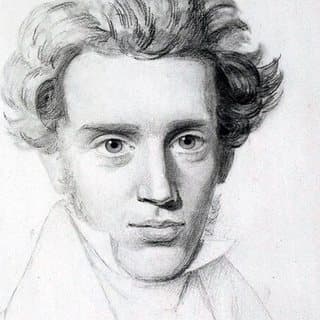
“It is really true what philosophy tells us, that life must be understood backwards. But with this, one forgets the second proposition, that it must be lived forwards.”
Testing the standard
Four cases from the article show where Aristotle's standard leads, and where it breaks down.
The classical standard
For this reason also a boy [sic] is not happy; for he is not yet capable of such [noble] acts, owing to his age; and boys who are called happy are being congratulated by reason of the hopes we have for them.
What the article observes
The idea of a “complete life” has largely faded from modern ideas of happiness: “who would describe a child at play as only ‘potentially happy’?” (p. 448). Yet the link between intellectual ability and happiness persists, explicitly or implicitly, in the “societal subconscious.”
The classical standard
A truly virtuous person must be able to give an account of why he is choosing to act virtuously and, further, must be able to choose virtue for its own sake rather than for instrumental reasons.
What the article observes
If reason is required for virtue, and that kind of virtue is required for happiness, people with intellectual disabilities are seen as “underdeveloped moral agents, incapable of full human flourishing” (p. 448). That presumption does not hold up: “countless people with intellectual disabilities live lives of flourishing and happiness – often in spite of difficult backgrounds and the systemic challenges of ableism” (p. 448).
The classical standard
Aristotle held the intellectual or contemplative life to be “best and pleasantest.” A good or moral life is happy only “in a secondary degree” (Aristotle, 2001, pp. 1105–1106; p. 447). On this view, those who think most about virtue should be best placed to live it.
What the article observes
Studies suggest otherwise. People who study ethics and morality professionally do not behave more ethically in practice (Schwitzgebel & Rust, 2014; p. 448). Intellectual ability does not automatically lead to virtue and flourishing.
The classical standard
He is happy who is active in accordance with complete virtue and is sufficiently equipped with external goods, not for some chance period but throughout a complete life.
What the article observes
If happiness needs a complete lifetime, it seems it can only be judged after death, and only from outside. Even near the end of life, rational capacities are almost surely diminished. As Kierkegaard observed, life must be understood backwards but lived forwards (1997, p. 306; p. 448).
Contemporary responses · pp. 452–454
Enfolding and expansion
How should theology engage thinkers like Augustine and Aquinas today? Ignoring them is not an option: their writing shapes the theological and pastoral landscape whether we acknowledge it or not. Following Elizabeth Antus (2013), the article distinguishes two postures.
Elizabeth AntusCatholic feminist theologian. Her essay “Disability at the Heart of Theology” (2013) names the two postures below.
Enfolding
Carries forward a normative theological anthropology tied to the “distinctively human” display of reason. It then shows that disabled people can still be fully included within it (Antus, 2013, p. 245).
Expansion
Pays “special attention to persons with disabilities, impairments, and illnesses first and foremost in order to rethink and expand an account of being human according to categories such as vulnerability, limitation, and (inter-)dependence” (Antus, 2013, p. 246).
- People without intellectual disabilities
- People with intellectual disabilities
Enfolding: included, but at the margin
Enfolding responses defend classical theologians by showing that people with disabilities remain fully human within their accounts, usually by virtue of the rational soul. Antus points to Miguel Romero's reading of Aquinas as an example. The article credits Romero with clarifying many misunderstandings. Yet his reading leaves untouched the view that disability is the “privation of a good that is due” (Romero, 2012, p. 107). The result keeps what Antus calls a “clear center” and a “clear periphery” (2013, p. 253).
“While these enfolding discourses may succeed in overcoming the human/subhuman dichotomy that has loomed large as a caricature in interpretations of these [historical] figures, they nevertheless retain a standard of normalcy for theological anthropology against which disabled people, especially intellectually disabled people, fare more poorly than non-intellectually-disabled people.”
Is the “privation” view common sense?
Even sympathetic readings of Aquinas treat it as common sense that disability is a privation, “not God's best for people.” The article asks where that belief came from in the first place:
“I suggest that it is largely due to the import of Greek philosophy and the assumption of a natural hierarchy of being, rather than any mandate of distinctly Christian theology.”
Judith SnowAuthor and advocate (1949–2015)
Presence and difference
“Walking is a gift. It offers the possibility of meaningful interaction. Not walking is also a gift – also creating the possibility of meaningful interaction. Speaking is a gift. Not speaking is also a gift. It is a different gift.”
Pearpoint & Snow, From Behind the Piano (1998, p. 3), quoted on p. 453
Looking forward · pp. 454–456
Vibrant theology in aporetic times
Aporia names the doubt or confusion Socrates produced in the people he questioned, by exposing contradictions in their own thinking. The word traces back to a lack of passage. We find wisdom in recognizing the limits of our thought, in knowing how much we do not know.
“As a shared human reality, constraints on the powers of thought are not, as such, an impairment – they are simply inherent in the ‘tool’ of cognition.”
“Neither works of piety nor works of morality nor works of intellect establish unity with God. They follow from this unity, but they do not make it. They even prevent it if you try to reach it through them.”
Pastoral deconstruction
With a heart for welcoming people with disabilities and their gifts into Christian community, pastoral deconstruction questions theological assumptions inherited from classical theology and Greek thought. It stays open to theological gifts that do not come from the exercise of human rationality (pp. 454–455). The article describes it working in three ways: in theory, in practice, and in how theology itself is done.
In theory
Answering bad philosophy
“Good philosophy must exist, if for no other reason, because bad philosophy needs to be answered.”
Bad theology has real effects on people's lives. Ironically, a Socratic posture of questioning lets us “run into” the barriers in these ways of thinking, then look to Christian and Christological priorities for a better way forward (p. 455).
In theology itself
Full-bodied theology
Purely theoretical modes of doing theology have their own barriers and limits. Full-bodied theology treats intellectual pursuit as “only one part of a vast scope of practice and relationships” (p. 455).
It welcomes liturgical and multidisciplinary experiences that honour the different ways of knowing of people with sensory impairments or diverse intellectual processing. It means practising faith in community with people with and without intellectual disabilities (pp. 455–456).
In practice · p. 455
When Steve makes loud noises in church
“When Steve makes loud noises in church, we have come to an impasse. Unspoken rules have been called into question. We are caught between a commitment to a space of uninterrupted (perhaps hyper-cognitive) learning and our love for Steve.”
What would your community do? Choose a response to see how the article reads it.
“Perhaps it is in these communities of faith that we will embrace the fullness of human flourishing – not in the heights of intellectual ascent but through the simple exercise of faithful love.”
p. 456
“Though you have not seen him, you love him; and even though you do not see him now, you believe in him and are filled with an inexpressible and glorious joy, for you are receiving the end result of your faith, the salvation of your souls.”
1 Peter 1:8–9 (NIV), the article's closing words
Read and cite the article
Abstract
From its inception, the Western theological tradition exhibits a fascination with and appropriation of ancient Greek philosophy. This conceptual intertwining of philosophy and theology, as exemplified by Augustine and Aquinas, privileges rationality in the “natural order” and in the pursuit of virtue and human flourishing. Despite generative insights at the intersection of disability and theology in other aspects, the “enfolding” tendencies of a conceptual framework inherited from Plato and Aristotle relegate people with intellectual disabilities to the margins of human flourishing. Contemporary theologians vary in the extent of their adoption of these norms and ideals related to the natural order and human rationality. The future of disability theology must engage a “pastoral deconstruction” that questions these deep privileging tenants of the Western intellectual tradition if it is to welcome the richly embodied theological contribution of people with intellectual disabilities.
Citation
Dow, K. (2022). Toward accessible faith & flourishing: Reconsidering Greek intellectualism in Western Christian theology. Journal of Disability & Religion, 26(4), 439–458. https://doi.org/10.1080/23312521.2021.1881023
Published online 8 February 2021. © 2021 Christian Horizons. Open access under a CC BY-NC-ND 4.0 licence.
Further listening and reading
Faith Today Podcast with Karen Stiller (March 2022)Toward Accessible Faith and Flourishing (opens in new tab)Journal of Disability & ReligionThomas L. Boehm’s guest editor introduction, which discusses the article (opens in new tab)Image credits
- Bust of Socrates, Louvre. Photo: Eric Gaba, public domain, via Wikimedia Commons.
- Bust of Plato after Silanion, Capitoline Museums. Photo: Marie-Lan Nguyen, CC BY 2.5, via Wikimedia Commons.
- Bust of Aristotle after Lysippos, Palazzo Altemps. Photo: Jastrow, public domain, via Wikimedia Commons.
- Philippe de Champaigne, Saint Augustine (c. 1645–50), LACMA. Public domain, via Wikimedia Commons.
- Carlo Crivelli, Saint Thomas Aquinas (1476), National Gallery, London. Public domain, via Wikimedia Commons.
- Niels Christian Kierkegaard, sketch of Søren Kierkegaard (c. 1840), Royal Danish Library. Public domain, via Wikimedia Commons.
- Elizabeth Antus and Judith Snow appear as monograms because no openly licensed portraits of them are available.